
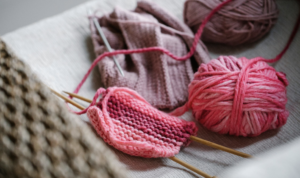
 Several respected studies have shown a correlation between knitting and brain health – allowing knitters to stave off dementia.
Your brain is constantly building connections between neurons. When you engage in complex activities like knitting, you strengthen existing pathways and create new ones. Knitting involves tracking stitch counts, remembering patterns, coordinating your hands with independent movements, and maintaining focus while your hands work almost automatically. Contast this with other pastimes like watching TV or listening to music which are quite passive.
Knitting engages your prefrontal cortex (involved in planning and decision-making), your motor cortex (controlling hand movements), your sensory cortex (processing touch and spatial awareness), and your temporal lobe (involved in memory and pattern recognition). All of these regions light up simultaneously during knitting, and each time they activate together, the connections between them strengthen.
Emotional health and cognitive function are deeply linked; chronic stress and anxiety actually accelerate cognitive decline. Studies show that knitting reduces cortisol levels while increasing serotonin and dopamine—the brain chemicals associated with mood regulation and emotional resilience.
Not a knitter? The protection from dementia comes from cognitive challenge, and not knitting itself. Anything that requires multiple types of mental processing at once will work. Any hobby that requires sustained attention, fine motor control, pattern recognition, and problem-solving will work – quilting, painting, woodworking, learning a musical instrument, or digital art— offer comparable cognitive protection.
